

Christmas dinner at the Reeds’ cottage, Scarborough, 1670.
In Scarborough Fair, Will Reed carves a goose for Christmas dinner in his mother Eleanor’s cottage. There’s spiced frumenty on the table and minced pies to pass. Before the evening is out, there are carols to sing. An older guest at that table could have remembered when Parliament expected December 25 to pass like an ordinary working day.
Did Oliver Cromwell really ban Christmas? The ban was real. Parliament abolished the observance of Christmas in 1647, six years before Cromwell became Lord Protector. His government later enforced restrictions on Christmas observance, which helps explain why his name has stayed attached to the ban.
Why Parliament Objected to Christmas
The first clash came during the English Civil War. In 1644, Christmas Day fell on the last Wednesday of December, a day already set aside for fasting and prayer. Parliament directed that the fast be observed. In June 1647, it went further, abolishing the observance of Christmas, Easter, and Whitsun as religious festivals.
What Happened When Christmas Day Came?
An ordinance could change the calendar on paper. Getting people to change what they did on December 25 was another matter. Shops and markets were expected to open, and authorities intervened to stop some celebrations. Protests broke out in Kent and elsewhere. Some families kept Christmas anyway.
When Charles II returned to the throne in 1660, the old church festivals returned to public life, and people could once again celebrate Christmas openly.
What Did Cromwell Want to Protect?
For Cromwell and many of his fellow reformers, the question was who had the authority to declare a day holy. Scripture tells of Christ’s birth, but it gives no command to mark it with an annual feast. Sunday, in their view, stood on firmer scriptural ground. Some reformers also saw the feast days as remnants of Roman Catholic worship and worried about the drunkenness that could accompany them. Parliament had already abolished the Christmas feast before Cromwell became Lord Protector, but his government continued to enforce restrictions on special Christmas services and took steps to make Sunday observance stricter. Both policies reflected the importance his government placed on how England worshipped.
There was another side to Cromwell’s religious policy. He allowed a wider range of Protestant congregations to worship according to their convictions. That liberty had sharp limits, especially for Roman Catholics. The same government that made room for some believers to follow their consciences could still tell other families and congregations how they were allowed to spend Christmas Day.
When Reform Reached the Church Windows
The dispute over holy days had a counterpart in the churches themselves. During the Civil War, before the Interregnum began, Parliament ordered the removal of objects it judged idolatrous or superstitious. In East Anglia, William Dowsing and his deputies broke some stained-glass images and pulled down crosses. Reformers feared such objects could draw devotion away from God. For some parishioners, those same images had helped tell the stories of Scripture and had been part of the church their families knew. The campaign began before Cromwell’s Protectorate, and the damage outlasted it. A feast could return to the calendar. A shattered window was harder to put back.
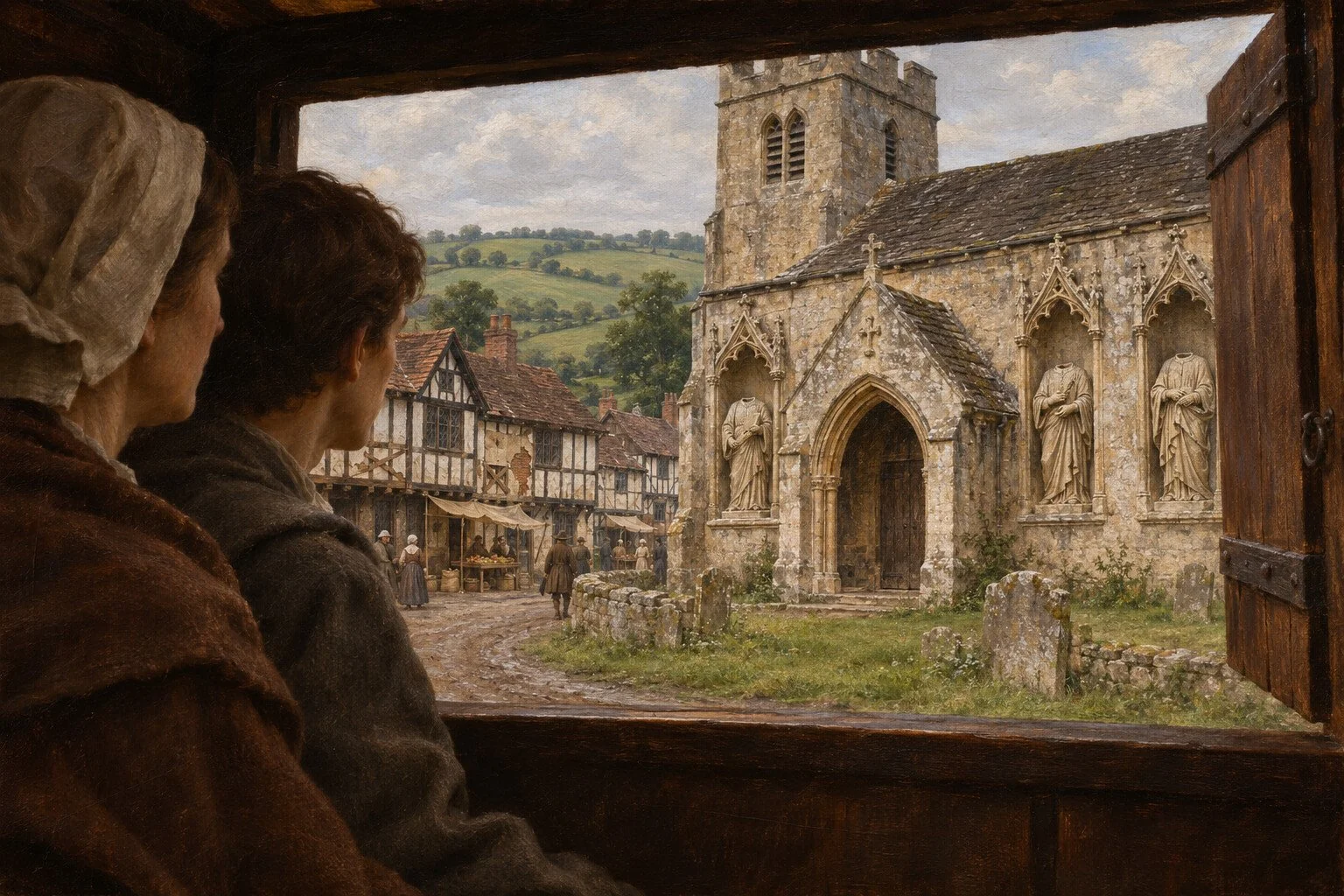
Tom and Martha pass a parish church with headless saints in its alcoves. An imagined scene from Chapter 15 of Scarborough Fair.
Christmas Dinner at the Reeds’ Cottage
By Christmas Day 1670, Charles II had been back on the throne for ten years. As Will Reed carves the goose in Scarborough Fair, the younger guests can take an open Christmas celebration for granted in a way Eleanor’s generation might not. I wanted the scene to feel like dinner in a fisherman’s cottage. There’s spiced frumenty on the table, there are minced pies to pass, and before the evening is out, there are carols to sing. For someone who remembered when Parliament expected December 25 to pass like an ordinary working day, being able to sing those old songs openly might have been the best part of the evening.
Step into Restoration-era Yorkshire in Scarborough Fair, Book One of the Heartsong Anthology.
